

 Auf Facebook teilen
 Tweet
Tweet
 Auf LinkedIn teilen
 E-Mail senden
 Mit Messenger teilen
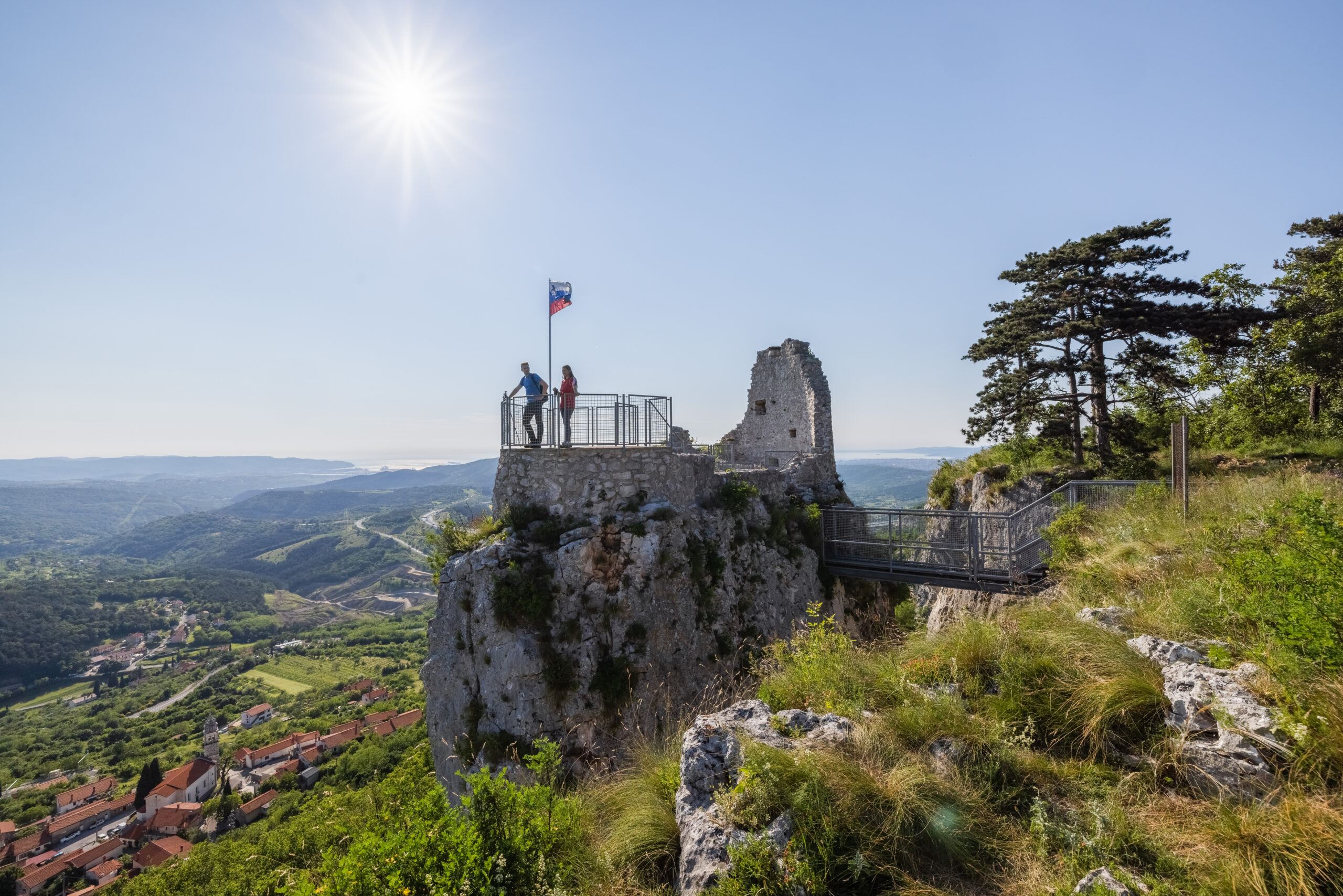
Črni Kal is a picturesque village located along the regional road between Koper and Ljubljana. A special landmark of the village is the Baroque-style Church of St. Valentine with a freestanding bell tower built in 1802, which leans noticeably due to the nature of the ground. This Karst-Istrian village is also home to many architectural gems, including Benko’s House from 1489 (listed in the Register of Cultural Heritage of the Republic of Slovenia), considered the oldest rural house in the Municipality of Koper.
The remains of the old castle lie above the village on the rocky edge. The fortress in Črni Kal was destroyed in 1615 during the Uskok War. Today, it survives only as a ruin.
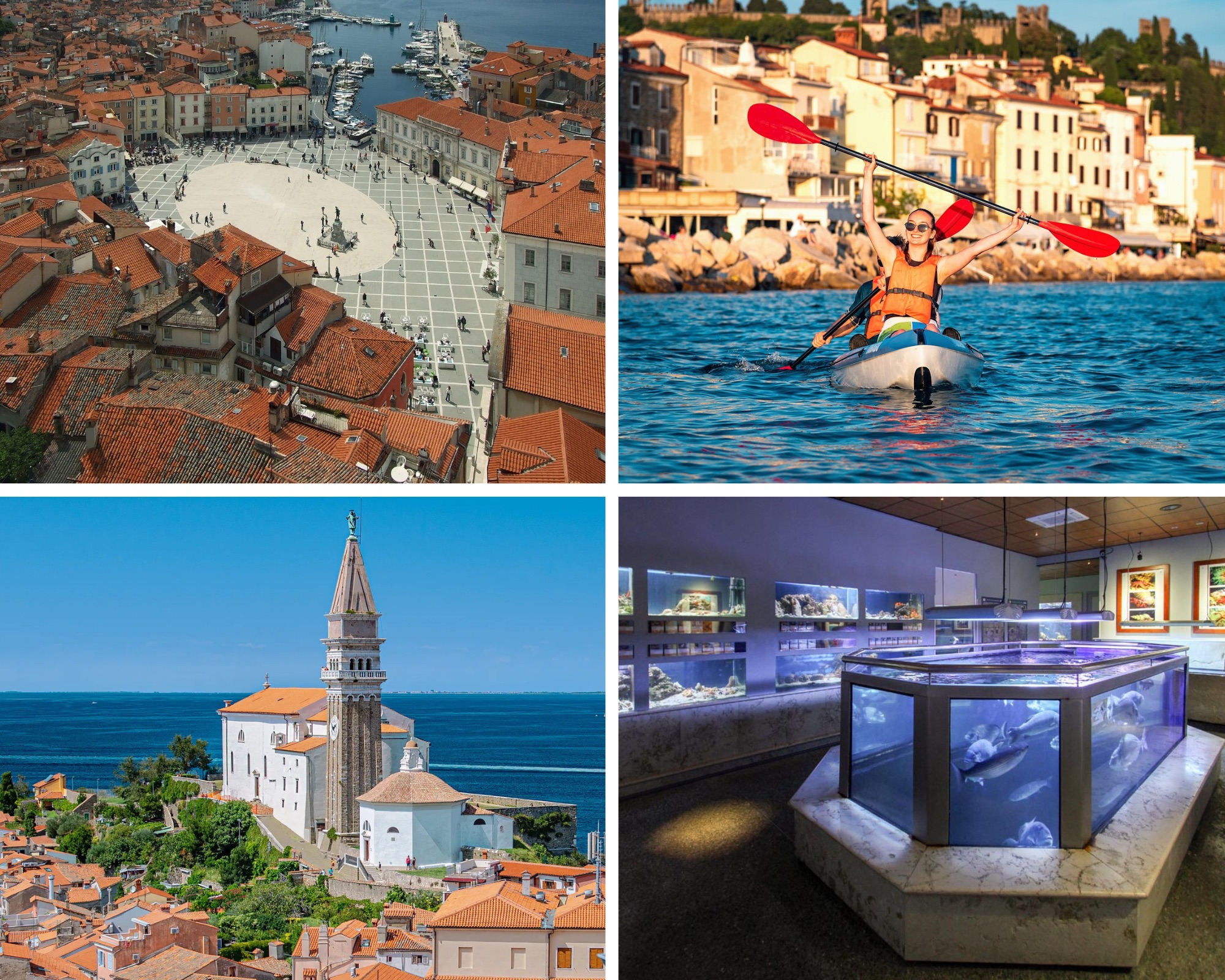
Above Piran rises the magnificent Church of St. George, named after the town’s patron saint, who, according to legend, saved it from a devastating storm. The church reached its present size in the 14th century and acquired its final Baroque appearance in the 17th century. Inside, it is adorned with seven altars, statues of St. George and St. Nicholas, a richly painted wooden ceiling, Venetian school canvases, and a Gothic Crucifixion from the early 14th century. St. George, depicted with a spear and shield, symbolizes the fight against evil, personified by the dragon. The freestanding bell tower of St. George, 46.4 meters high with four bells, is topped by a statue of Archangel Michael, which turns with the wind to forecast the weather. From the top, the bell tower offers spectacular panoramic views in all directions.
While in Piran, you can also visit the Piran Aquarium, Tartini Square, the town walls, and stroll through the charming medieval streets.
Piran can also be explored from a different perspective. Sea Kayak Piran offers the chance to admire Piran and its coastline from afar, while enjoying the morning sun or a romantic sunset from the water. Sea kayaking is suitable for families and couples alike. Each trip begins with a short introductory lesson to ensure everyone feels safe and comfortable. Beginners are most welcome! Info and reservations: https://seakayakpiran.com
Hubelj is a river, and in rainy seasons a torrent, that flows through Ajdovščina. It rises from three karst springs—or waterfalls—at the foot of Navrše Hill, 2.5 km north of the town, and joins the Vipava River near the village of Dolenje. The waterfalls can be seen only in wetter periods. At the source, you will find a restaurant, a former military barracks, and a circular nature trail with displays of various tree species and rocks. The Hubelj bursts from the karst underground beneath the steep slopes of the Trnovo Forest, especially after heavy rainfall. It is believed that the river may even be hydrologically connected with the mysterious Wild Lake near Idrija. For more than a century, the Hubelj has been the main source of drinking water in the Vipava Valley.

Lipica is the cradle of the Lipizzaner horse and the largest stud farm of its kind in the world. Its unique story began in 1580. The Lipizzaner is one of the oldest cultural horse breeds in Europe and the world. Today, the Lipizzaner is best known as a white horse—though in reality, these horses are usually born dark and gradually turn grey due to a genetic mutation.
The Lipica riders will introduce you to everything you ever wanted to know about horses: why they have hooves, how their digestion works, how they sleep, and even why “you don’t look a gift horse in the mouth.” Meeting these noble animals is an unforgettable opportunity for curious visitors of all ages to experience direct contact with the horses and ask the riders questions.

The Ferrari Garden was built between the two World Wars as part of Villa Ferrari, owned by Trieste physician Enrico Ferrari, who wanted to establish a country villa and sanatorium for lung patients in Štanjel. The garden was designed by architect Maks Fabiani in terraced form, inspired by the structure of the old town of Štanjel. The terraces were planted with vegetables and flowers, and the trees were mostly Mediterranean species. Fabiani adapted his work to the terrain, combining traditional Karst stone retaining walls and stairways with elements that reflected the ideals of the time, even if they did not belong to the Karst environment. Among these are a viewing pavilion, fountains, and an artificial grotto. The garden’s most recognizable feature is its oval pool with an island, fed by a complex water system. Today, the Ferrari Garden is recognized as a cultural monument of national importance.
In Štanjel, every stone tells its own story. The hill was inhabited as early as prehistoric times; Roman remains testify to its ancient past, while the mighty castle and clustered village evoke medieval life. An interactive exhibition at Štanjel Castle engages all the senses: touch the Karst stone, feel the force of the burja wind blowing at 120 km/h, discover the unique water supply system of Štanjel, and explore the natural riches of the Karst.

Hrastovlje is a clustered village rich in history and art. Above the settlement stands the Church of the Holy Trinity, home to exceptional frescoes painted in 1490 by Janez of Kastav. Among them, the famous Dance of Death is considered a masterpiece of medieval iconography. The village is also characterized by its stone houses, narrow streets, carved stone portals, and 16th-century defensive walls. Surrounded by vineyards, olive groves, and typical Karst stone landscapes, Hrastovlje has a unique charm. The Hrastovlje educational trail passes through the characteristic Istrian nature. Local farms and wine cellars in the village and nearby offer tastings of local wines (Malvasia, Refosco) and Istrian specialties such as prosciutto, cheese, and olive oil.

The Coastal-Karst region in southern Slovenia offers exceptionally diverse cuisine that blends the flavors of the sea with those of the Karst inland. On the coast, seafood specialties dominate—fresh fish, shellfish, and octopus salad, often served with olive oil from local groves. On the Karst, the unmissable delicacy is prosciutto, air-dried in the burja wind, paired with teran, the robust red wine grown in the unique Karst soil. Other typical dishes include jota (a stew of sauerkraut, potatoes, and beans), štruklji, and Karst cheese. The food of this region is authentic and rich, strongly influenced by Mediterranean and Karst traditions, enhanced by the hospitality of the locals and the beauty of the natural surroundings.
Auf Facebook teilen
Tweet
Auf LinkedIn teilen
E-Mail senden
Mit Messenger teilen


